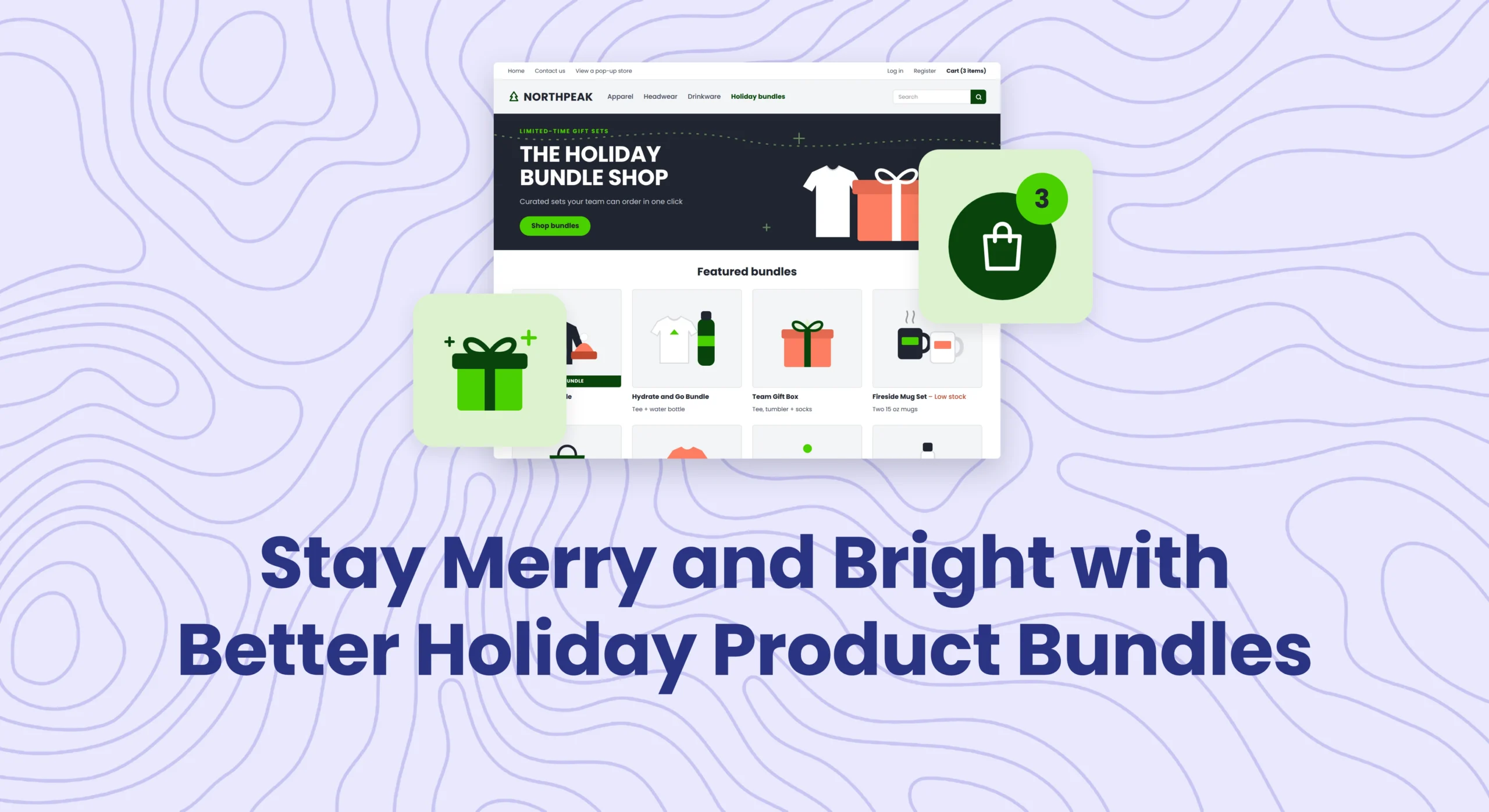
Online holiday stores can help distributors, decorators, and branded merchandise sellers create new opportunities for their customers during one of the year’s busiest selling seasons.
But a successful holiday store often depends on the product assortment. If a catalog is too broad, your shoppers may struggle to choose, while if it’s too limited, it might deter some people due to budget constraints, differing audiences, or gifting needs.
Product bundles offer a practical middle ground. By combining apparel with useful hard goods, you can help customers create more thoughtful gift options while giving shoppers a clearer path to purchase.
If you’re interested in getting an in-depth look at how holiday and end-of-year stores can help you generate an average of more than $3,000 per store, join us on October 15th, 2026, at 1 p.m. CT for our live session with helpful tips and tricks. Sign up here.
Why holiday product bundles work
A well-designed bundle helps customers:
- Simplify product selection
- Support a defined budget
- Create a stronger perceived value
- Offer options for different audiences
- Increase the number of items included in an order
- Feature more products without overwhelming shoppers
OrderMyGear’s 2025 holiday store data found that bundles averaged a $138 average order value (AOV) and 4-5 items per order, compared with an $89.79 AOV and 2-3 items per order for other holiday purchases.
Jackets also averaged $6 more per order during the holiday season than during the rest of the year. These results are not guarantees, but they suggest that customers may be willing to spend more when a holiday store offers useful, giftable products.
Start with the customer’s goal
Before choosing products, determine the bundle’s purpose or application.
Consider:
- Who’s the recipient?
- What is the occasion?
- What is the customer’s budget?
- Is the offer intended for employees, clients, partners, teams, or members of the organization?
- Does the customer need one option or tiered pricing?
- Will the bundle be purchased through an online store or redeemed through a Redemption Store?
These answers will influence the products you recommend, the number of options you create, and how the store should be organized.
Common bundle strategies
There are several different approaches you can use to build targeted bundles:
- Apparel and hard goods: Pair a hoodie, jacket, or sweatshirt with a complementary item, such as a backpack, blanket, cooler, or chair.
- Apparel-only bundle: Offer a coordinated set of apparel, such as a sweatshirt, tee, and a hat, all bearing the same logo or artwork.
- Good, better, and best tiers: Create three tiered options for varying budgets.
- Recipient-choice bundle: Let recipients choose from a defined collection.
- Premium gifting bundle: Combine higher-value apparel and hard goods for executives, VIPs, or key partners.
- Budget-conscious bundle: Focus on accessible, practical products for a broad audience.
Build a focused product mix
Creating a focused assortment makes a store easier to navigate and helps reduce the paradox of choice, where shoppers are so overwhelmed by options that they don’t make a purchase. Instead, it helps guide them to the checkout process faster.
Start by giving each product a clear role.
| Bundle role | Product examples |
| Core Apparel | T-shirt, hoodie, hat |
| Secondary apparel | Sweatshirt, jacket, quarter-zip |
| Hard Goods | Backpack, chair, small cooler |
| Premium Goods | Bluetooth speaker, high-end cooler, premium jacket |
| Seasonal Add-on | Giftwrap or message card |
Lead with a hero product
Every bundle should have a product that immediately communicates its value. This might be a branded hoodie, a quality jacket, a quarter-zip, or another product that fits the customer’s audience and budget.
The hero product should be:
- Relevant to the recipient
- Available in the needed sizes and colors
- Supported by strong photography
- Easy to describe
- Available in the required quantities
- Appropriate for the customer’s brand
Add something useful
Hard goods can make a bundle feel more complete and practical. Consider products such as backpacks, bags, blankets, coolers, chairs, pens, speakers, or tech accessories.
Include a premium upgrade
A premium upgrade gives customers a way to offer higher-value options without building another store.
Possible upgrades include:
- A premium jacket instead of a sweatshirt
- A Bluetooth speaker instead of a small cooler
- A premium-quality travel bag instead of a budget backpack
- A higher-end quarter-zip instead of a hoodie
For many holiday stores, a focused selection of approximately five to eleven products can make it easier for shoppers to choose while helping customers maintain a manageable assortment.
Offer good, better, and best options
Tiered bundles can help you serve different audiences while keeping the store organized.
| Tier | Intended audience | Example structure |
| Good | Broad employee or team audience | Core apparel plus a practical add-on |
| Better | Key customers, partners, or leadership | Upgraded apparel plus a high-value hard good |
| Best | Executives, VIPs, or milestone recipients | Premium apparel plus premium hard goods |
For each tier, consider:
- Budget per recipient
- Product cost
- Decoration or setup costs
- Shipping costs
- Free-shipping thresholds
- Minimum quantities
- Inventory availability
- Expected average order value
- Whether the bundle will be purchased or redeemed
A good-better-best structure can help customers identify different groups without having to manage multiple unrelated stores. If each audience needs a different assortment, consider organizing those options with separate product collections or Code Groups.
Make the bundle easy to shop
Once the product mix is set, focus on how the bundle will appear in the online store.
Give it a clear name
Use a unique name that tells shoppers what the bundle includes and who it is for.
Examples include:
- Employee Appreciation Bundle
- Winter Warmth Bundle
- Premium Partner Gift
- Team Travel Bundle
- Holiday Essentials Pack
Avoid names that are creative but too vague. Shoppers should understand the offer before opening the product page.
Explain what is included
The description should clearly identify:
- Every product in the bundle
- Available sizes and colors
- Decoration details
- Product limitations
- Shipping or fulfillment expectations
- The intended use or audience
Show the complete bundle in the product image whenever possible so shoppers understand what they’re getting.
Highlight the add-on
If the hard goods differentiate the bundle from a standard apparel order, make that benefit clear.
For example:
Pair a branded quarter-zip with a durable backpack for a practical gift recipients can use at work, while traveling, or at events.
Use featured products and gift guides
Place bundles where shoppers can easily find them. Consider categories such as:
- Holiday Picks
- Staff Favorites
- Premium Gifts
- Gifts Under $50
- Bundles and Sets
- Ships Fast
Use incentives
A coupon can help create urgency or support a higher-value order. Free shipping may also be worth testing when the bundle price is high enough to support the cost.
The OrderMyGear holiday blog reported that free shipping coupons increased holiday store sales by 12% in 2025. Use this as a testable tactic, not a guaranteed result, and evaluate it against the customer’s margins, average order value, and fulfillment model.
Use OMG features to manage the bundle experience
Once the product strategy is complete, OMG can help turn the plan into an organized online-store experience.
Depending on the program, you can:
- Create Product Bundles
- Organize products into Featured Products or Gift Guides
- Use Code Groups for different audiences
- Assign different product selections or budgets
- Add coupons
- Monitor inventory availability
- Copy an existing store or template
- Add thank-you messages or videos
- Review product and order performance through reports
Live Inventory can also help you identify available products as you build the store. Before launch, review both product availability and fulfillment timelines so the bundle remains viable throughout the selling period.
Complete a final review before launch
Before sharing the store, use this checklist to confirm the store is ready:
- Are all included products in stock?
- Are the required sizes and colors available?
- Are product images and descriptions current?
- Are bundle prices accurate?
- Are coupon terms and deadlines clear?
- Is the bundle easy to find?
- Have purchase or redemption paths been tested?
- Does the store work well on mobile devices?
- Is the fulfillment timeline realistic?
- Can performance be reviewed in reports after launch?
A short review before launch can help prevent avoidable issues with product, pricing, inventory, and fulfillment once the store is live.
Build better holiday stores with thoughtful bundles
Holiday product bundles give OMG customers a practical way to guide shoppers, accommodate different budgets, and drive more valuable online store orders.
Don’t forget to sign up for our October 15th free session on how to boost revenue with holiday stores. Sign up here.
Ready to create your next online store? Book a demo to see how OrderMyGear can help you build curated online-store experiences for your customers.