Branded merchandise has its own language, including pricing acronyms, online store categories, supplier tools, and fulfillment terms. This branded merchandise glossary breaks down the key branded merchandise terms distributors, decorators, dealers, suppliers, and growing promo businesses need to know, so you can better understand the industry, explain options to customers, and navigate the technology that helps you sell branded merch more efficiently.
For a broad overview of industry terms and trends, check out our Technology State of the Union here.
Affiliate Network
Affiliate Network – An individual/company that earns a commission selling on behalf of a parent company while maintaining ownership and independence of their company and name. Affiliates are typically provided a pool of business resources, such as marketing, technology, IP, and other sales resources. Common affiliate networks in the promo and apparel industry include American Solutions for Business (ASB) and HALO Branded Solutions.
API (Application Programming Interface)
API (Application Programming Interface) – Acts as a data conduit between two programs/systems, such as an order management platform and a third-party logistics software. Some businesses and companies use APIs to connect their own proprietary apps or programs with industry solutions. OMG has APIs for several solutions, allowing you to connect your OMG Online Stores with your other systems, as well as the OneSource API to access PromoStandards-compliant product data from industry suppliers from one place.
Average Order Value (AOV)
Average Order Value (AOV) – The average amount customers spend per order. AOV can be calculated by dividing total sales by the total number of orders.
Branded merchandise
Branded merchandise -Customizable products intended for enhancing brand visibility and loyalty. Typically, branded products feature a company or entity’s logo, artwork, or slogans. Common merchandise includes branded apparel, office supplies, and accessories like headwear and water bottles.
Buying Group
Buying Group – A group of companies that leverage their collective buying power to secure better pricing from suppliers. Companies pay a fee to join & may be independent or part of a franchise or affiliate. In the sporting goods market, Sports Inc. is a classic example of this model.
Commercial Printer
Commercial Printer – A business that specializes in high-volume printing for promotional purposes such as tradeshow displays, backdrops, and banners. Often includes screen printing and offset printing with order quantities in the thousands.
Company Swag
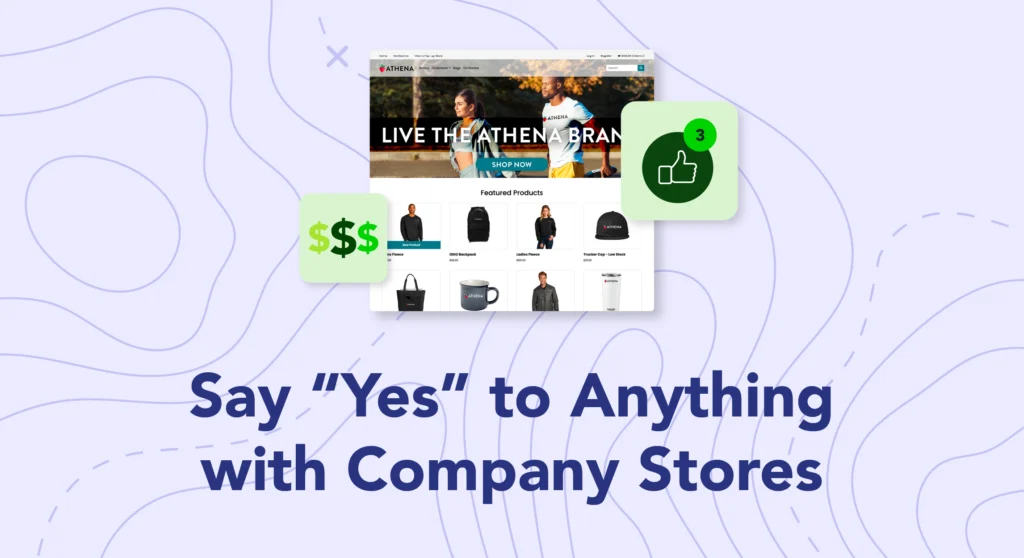
Company Swag – A program used to provide a company’s employees with branded merchandise, which can be supported by an online store where employees place orders for preselected items or through a bulk order placed by one person on behalf of the group.
Here’s an example of a swag shop.
Contract decorator
Contract decorator – A company whose core business is embellishing blank products and/or apparel on behalf of other companies, such as promotional product distributors, team dealers, and even other decorators. Also known as a trade-only decorator.
- Has a physical shop, often with multiple machines
- Does not work with end consumers
- Their brand is not shown to the end consumer
Corporate Gifts
Corporate Gifts – A program that provides a company’s customers or prospects with a gift and is often supported by an online store. The store typically does not collect payments; instead, it allows visitors to redeem a code or credit for a product.
Here’s an example of an OMG Redemption Store for a corporate gift program. Enter OMG123 to access the demo store.
Custom Domain
Custom Domain – A branded web address that usually incorporates a business’s name (e.g., ‘XYZPromoBiz.com’). Typically purchased through a third-party domain-hosting service. Custom domains help enhance a business’s credibility and online search visibility. Here’s why.
Decorator
Decorator – A company/individual that sells and decorates customized products, apparel, and/or signage to organizations in a variety of industries. Also known as a printer or fabricator.
- Have a physical decoration shop and/or active showroom
- Provide comprehensive graphic design services and sign installation services
- Sell directly to customers and end consumers, making money on all components of the sale: markup, decoration costs, and services
- May provide some contract decorating on behalf of other distributors/dealers, but not as a primary business.
- Often use decorative terminology in business names (e.g., print, engraving, screen printing, sign, etc.).
Decorator Network
Decorator Network – A program often offered through a supplier that simplifies apparel customization by connecting its customers with a network of decorators. Typically, bundles offer perks like shipping discounts (or free shipping) and provide an array of embellishment services, such as direct-to-film (DTF), screen printing, and embroidery. Here’s how OrderMyGear works with STAHLS’ Fulfill Engine to provide a decorator network to businesses.
Digital Advertising
Digital Advertising – Product placement, which boosts visibility in search engine results, digital banner ads within OMG applications promoting supplier products and services, ad spots in OMG’s newsletters, and emails sent on behalf of the supplier to distributors, decorators, and dealers.
Electronic Purchase Order (ePO)
Electronic Purchase Order (ePO) – Similar to a regular purchase order, but sent and processed entirely online for expedited ordering. It may also be referred to as integrated purchasing or automated purchasing.
Employee Recognition
Employee Recognition – A program for company employees with gifts as a thank-you for achieving a goal or to express appreciation, and often supported by an online store. Because this store provides branded merchandise as gifts, it typically does not collect payment.
Employee Uniforms & Supplies
Employee Uniforms & Supplies – A program that provides employees with uniforms and work supplies. It’s usually supported by an online store where employees can place orders for preselected items, or by a bulk order placed by one person on behalf of the group.
Here’s an example of an OMG Company Store for an employee uniform and supplies program.
End quantity pricing (EQP)
End quantity pricing (EQP) – EQP is the end-column price in a pricing grid from suppliers, or the price of the highest-volume purchase from a supplier. Most suppliers offer price breaks for larger quantities, especially as retailers’ order quantities increase. Occasionally, suppliers offer EQP at a lower order quantity as an incentive to a buyer.
Franchise
Franchise – An individual/company that pays a fee to use the name, logo, business model, etc. from a franchisor. Typically, a franchisee agrees to adhere to the franchise’s specific marketing and operating standards. The franchise pays an initial investment fee and handles marketing fees and/or royalties. Big Frog Custom T-Shirts & More is an excellent example of this type of franchise in our industry, and uses OMG to power its online stores.
Fundraiser
Fundraiser – A program used to raise money for groups or organizations like non-profits and school teams/clubs, often supported by an online store. This type of store may include a fundraising tracker that shows the percentage toward the goal, or a timer showing how much time remains before the fundraiser ends.
Here’s an example of an OMG Pop-up Store for a high school fundraiser supporting their team.
GTIN (Global Trade Item Number)
GTIN (Global Trade Item Number) – Via GS1, a GTIN is a 14-digit number that “defines trade items as products or services that are priced, ordered, or invoiced at any point in the supply chain.”
Holiday/Event
Holiday/Event – Seasonal campaigns/programs built for a short-term purpose. The accompanying online store is used to sell products for events, holidays, and/or seasons. (e.g., concert, 5K, Christmas)
Inventory program
Inventory program – A program where the distributor, decorator, dealer, or print shop holds pre-decorated products on behalf of the customer and ships products to consumers (also known as end users) as orders are placed on an online store. The customer typically pays for the products in advance and may incur an additional storage fee. Because the merchandise has already been paid for, consumers typically do not have to provide payment information at checkout. Common use cases for inventory programs include company swag, employee uniforms & supplies.
Kitting
Kitting – The process of combining separate products and SKUs into a new, single SKU for a custom product offering. This is most commonly used for building promotional packs, starter kits, and other specialized bundles, and is often aimed at customers like corporate clients who need a complete kit of branded products (e.g., a mouse, pen, and tumbler with the company’s logo/colors, all in high-quality, branded packaging).
Minimum Order Quantity (MOQ)
Minimum Order Quantity (MOQ) – Minimum order quantity (MOQ) is the smallest amount of units or order value required to purchase from a supplier in a single transaction. This maximizes profits for manufacturers and suppliers, and helps set the stage for bulk discounts for retailers.
Multi-factor Authentication (MFA)
Multi-factor Authentication (MFA) – A security process/protocol for websites that requires users to provide two or more verification factors, such as a pin or biometrics, to access an account. MFA adds a second layer of protection beyond a simple password and is commonly used on sites that store sensitive data, such as credit card numbers and personal information.
Multi-line rep
Multi-line rep – An individual contracted by one or more suppliers to market their products and services to distributors, decorators, dealers, and print shops. They are an extension of suppliers, selling products on behalf of multiple suppliers that do not compete with one another. Often self-employed, commission-based, and focused on a specific region or sales territories.
Online Store
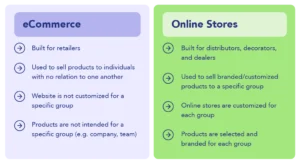
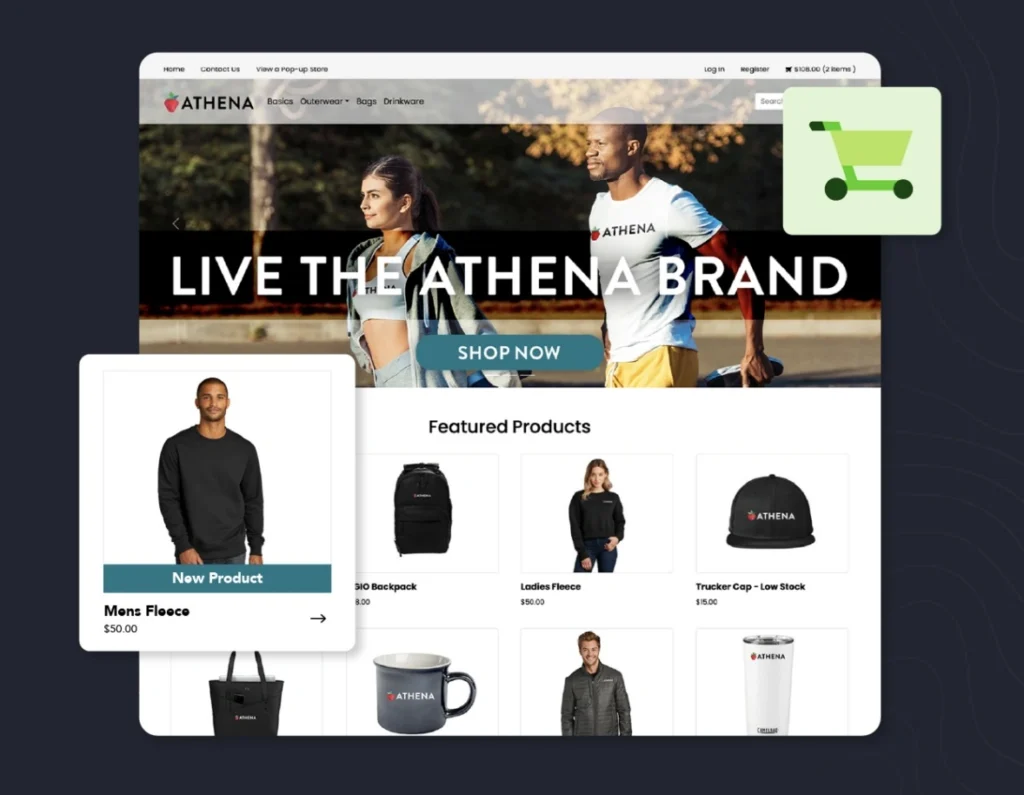
Online Store – Software used by distributors, decorators, and dealers to create custom-branded, retail-like online stores for their customers to place orders for branded merchandise. Online stores are created for a specific group with products selected and branded with their logo. Common types of online stores include Pop-up Stores, Company Stores, Redemption Stores, and Fundraising Stores.
Online Stores
Online Stores – A website where a business sells products for purchase. Online stores are sometimes standalone entities from a business’s main website, or can be embedded into an existing website.
Order Management
Order Management – Software used by distributors, decorators, and dealers to manage orders across all of their sales channels (e.g., presentation, online stores, their company website, orders via email or phone, etc.). Order management platforms typically include inventory management, operational reporting, and built-in accounting capabilities or integrations. Also commonly referred to as an enterprise resource planning (ERP).
Presentation
Presentation – Software used by distributors, decorators, and dealers to create and share customized, interactive presentations, pitch ideas, and generate orders for customers. It may also be called a proposal. Check out OMG’s presentation resources here.
Pricing
Pricing – The process of determining a monetary value for goods and services.
Print-on-demand (POD)
Print-on-demand (POD) – A structure that automates the online fulfillment process for promotional product distributors, apparel decorators, and team dealers where low-quantity and/or one-off orders are handled by a third-party, freeing up the business’s time to focus on their revenue centers.
Here’s how OrderMyGear works with STAHLS’ Fulfill Engine to offer POD resources.
Product Listing
Product Listing – A platform and marketplace where suppliers can list their searchable, brandable products for distributors, decorators, dealers, and print shops to pitch and sell to their customers.
Product Search
Product Search – Software used by distributors, decorators, dealers, and print shops to search for customizable products from wholesale industry suppliers. A product search tool like OMG acts as a search engine and marketplace, similar to Google, but is specifically designed for finding blank promotional products, apparel, and other products that can be customized with a group’s logo, artwork, etc.
Product search tools let you search by keyword, supplier, and SKU, and offer filters to refine results further and find options that meet your specific needs.
PromoStandards
PromoStandards – A non-profit organization that publishes open source specifications and standards for how to share data in the promotional products and branded merchandise industry. It’s a standardized format for data that makes it easier to share information and process orders between suppliers, distributors, and service providers.
PromoStandards Data Services
PromoStandards Data Services – A platform suppliers use to transform their product data to PromoStandards, the industry-preferred format, and distribute it to customers and technology partners.
Promotional product distributor
Promotional product distributor – A company/individual that sells branded promotional products, corporate apparel/uniforms, gifts, and other branded swag to organizations, like companies and non-profits.
- Rarely have physical storefronts or showrooms with inventory.
- Often have distributed sales reps who work remotely nationwide or globally.
- Work primarily with companies/organizations outside the sports market
- Sell branded promo hard goods, such as pens and mugs, alongside apparel.
- May also sell apparel to schools/teams, but does not sell sporting hard goods.
- Limited in-house graphic design services
- Rarely provide in-house decoration or contract decoration services
Promotional products
Promotional products – Similar to branded merchandise, but a broader category of products imprintable with company logos and artwork, ranging from smaller items like pens and pencils, to larger products like tote bags, backpacks, and stadium chairs.
Proof
Proof – A lower-resolution version of a print-ready file that shows customers what the final branded product they’re ordering will look like with the requested artwork.
Punchout
Punchout – A direct connection between a B2B eCommerce platform and a shop’s purchasing system. Punchout allows shops to use their own ERP system and connect to their supplier’s online catalog. Here’s a full explanation of how punchout works.
Purchase Order (PO)
Purchase Order (PO) – A document that shops and decorators use to purchase goods from suppliers. POs typically feature quantities, agreed pricing, and product types. While POs are a relatively standard-issue piece of paperwork for shop owners, they also help maintain price transparency between suppliers and retailers.
Retail
Retail – A program for selling retail products to an end-consumer/general public for their own use (e.g., a Whataburger merchandise store for customers)
Setup charge
Setup charge – A one-time fee a customer pays to a decorator or supplier for preparing the machine and materials required to apply artwork to a product. The fee is not included in the blank product price and typically applies across products using the same artwork.
Shop Management
Shop Management – Software used by distributors, decorators, and dealers to manage orders across all sales channels (e.g., presentation, online stores, their company website, orders via email or phone, etc.), as well as manage the production/decoration of products post-order. Shop management platforms typically include inventory management, job scheduling, operational reporting, and built-in accounting capabilities or integrations. Sometimes referred to as production management.
Sign Shop
Sign Shop – A business that offers an array of customized sign services like printing, fabrication, and installation. Selection of products and services can vary by business type and size, but usually includes vehicle wraps, banners, storefront signs, and ADA-compliant signage. Products often include acrylic, aluminum, A-frame, and vinyl signage.
Single Sign On (SSO)
Single Sign On (SSO) – An authentication method that allows users to log in across multiple platforms/programs with a single credential set. SSO is often combined with Multi-factor authentication (see below) for robust online security.
Software
Software – A set of instructions or program(s) used to perform certain tasks that operate computers and perform specific tasks. Essentially, a set of instructions that tells a device like a phone or laptop what to do. In the world of custom-branded merchandise, users need software for everything from customer relationship management to order management.
Spirit Wear
Spirit Wear – A program used by schools and teams to provide students, parents, and communities with merchandise that helps demonstrate their support. An online store often supports Spirit wear programs and includes a variety of options, including apparel and hard goods. Here’s an example of an OMG Pop-up Store for a high school.
Stock keeping unit (SKU)
Stock keeping unit (SKU) – A unit of measurement that helps keep track of product inventory and is typically connected to a product barcode. A SKU number stores key attributes such as manufacturer, material, color, sizing, and product details. In many cases, each character in a SKU represents an attribute such as size, color, or material.
Supplier
Supplier – A company that manufactures, imports, or otherwise produces and sells blank, customizable products to promotional product distributors, decorators, printers, and team dealers. Suppliers usually sell products from multiple brands and may have their own brand(s). Some also decorate products for their customers.
Examples: SanMar, S&S Activewear, Under Armour, Charles River, and HIT Promo.
Supplier Terms
Supplier Terms – A formalized, legally-binding agreement between a supplier and buyer on key details of doing business, like payment terms, quality guarantees, and shipping times.
Supplier Website
Supplier Website – Software used by suppliers to create a website and promote their business and products to distributors, decorators, dealers, print shops, and other resellers. The website is primarily used as a marketing and lead generation tool that allows website visitors to search the supplier’s catalog, request more information about a specific product, request a quote, access supplier-created sales assets like catalogs and sell sheets, view account-specific pricing, place orders online, and view their account and order history. Some sites are e-commerce-enabled.
Team Dealer
Team Dealer – A company or individual that sells customized team uniforms, sporting goods equipment, and/or apparel to schools, teams, and local businesses.
- Likely have a physical storefront or showroom
- Work primarily with teams at K-12 schools, colleges, and sports leagues
- Sell custom team uniforms, sports equipment, and spirit wear
- Typically working with sports suppliers like Under Armour & Adidas
- Limited in-house graphic design services
- Usually holds inventory
- Some level of in-house decoration, but generally focuses on team customers.
Team Uniforms & Equipment
Team Uniforms & Equipment – An online store that provides sports teams with uniforms and equipment.
Check out this Online Store Use Case eBook for more ideas about how to run these types of online stores for your customers and browse professionally built demo stores to get inspiration or use them as a sales tool to pitch to your customers.
Trade Show
Trade Show – Events where manufacturers, suppliers, and distributors converge to showcase their products and services. There are countless annual trade shows for the promotional products and branded merch industry, both across North America and internationally. Some popular shows include Sports Inc (sporting goods), PPAI (promotional products), and Impressions Expo.
Website
Website – Software distributors, decorators, and dealers use to create a website to market their business and share information about the products and/or services they provide. The website is primarily used as a marketing and lead-generation tool, allowing website visitors to request more information about specific products and/or request a quote. The website may or may not be eCommerce-enabled.
Here’s a look at the differences between an e-commerce website and an online store: